![AgeWise King County [logo]](https://www.agewisekingcounty.org/wp-content/themes/agewisekingcounty/images/logo.png)
The Nurturing Power of Nearby Nature

After 31 years as a lawyer and 10 years on the Seattle City Council, I did something I’d wanted to do for a long time: I became a Master Gardener through the WSU Extension/King County program. Now, instead of my City Council pin, I proudly wear the badge of a Master Gardener.
Despite living in a downtown Seattle high-rise, I’ve found innumerable opportunities to donate my time and dig in the dirt with friends: local gardens in need of weeding, daffodil bulbs ready to plant in Belltown, and family and neighbors open to creating pollinator pathways in their yards. Nothing says love like showing up in someone else’s garden with a pallet full of perennials and a shovel.
Hanging around people and places where things are growing is good for us. It’s not just my endorphins talking—there is documented science behind that statement. Even if you are not doing the gardening, access to trees, plants, and green spaces increases longevity and certainly makes our lives livelier.
I am grateful for new connections made with like-minded gardening friends willing to share their wisdom. I’ve worked with dedicated women who have volunteered for over a decade to improve Carkeek Park, as well as Plant Amnesty volunteers who spent hours climbing on orchard ladders pruning 30-year-old wisteria vines in Magnuson Park.
My knees don’t bend like they once did, but gardening and promoting our city’s parks and green spaces are still some of my favorite activities. For me, weeding and pruning are happy distractions from the national news.
The Master Gardener program has nine priorities. My favorite is “to increase access to plants, green spaces, and public landscapes to benefit the health & well-being of all members of our communities.” This is so true. I strongly believe that community is where magic happens.
When I was on the Seattle City Council, I worked to get Seattle designated as an Age Friendly City, a city that identifies and addresses barriers to the well-being and participation of older people. Topping my list for smart urban planning is to make the clean and green environment accessible to people of all ages and abilities.
Much has been written about the negative impacts of social isolation and loneliness. It’s a downward spiral—you’re sad because you’re lonely, and you don’t want to go out because it’s just too darn depressing. So you stay inside, staring at the walls or the television, feeling worse.
Breaking that cycle requires guts—or the help of a willing friend who will invite you to take a walk through the Arboretum, or urge you to bring your binoculars along and identify Buffleheads and Common Goldeneyes on Lake Washington. Being able to get outside even for a few minutes or a few blocks hits the reset button. Building our cities to be green, connected, and accessible is necessary for an Age Friendly Community. That’s how I want to live and why I volunteer.
My husband, Brad, and I regularly stroll the promenade on Seattle’s new 20-acre Waterfront Park. Every walk is a delight. The recently planted trees are leafing out and thousands of plants and bulbs are blooming. The park is alive with happy couples holding hands and dogs on leashes, parents pushing babies in strollers, seniors jogging and people like my husband capably getting around on a mobility device. Most bike and scooter riders stay in their own protected lanes. There’s no way you can feel isolated down there!
So, here’s my thesis: Walking regularly through a park, admiring a tree-lined street in your neighborhood, joining a group to rip ivy off established trees or to plant new ones, are all wellness practices that I recommend people engage in. Doing them with friends is even better.
An older gardening friend once told me her secret to happiness was to follow BOB Rule: Be in the moment, Outside focus on the trees and green, and Breathe intentionally. It works wonders for me, and I hope it does for you too.
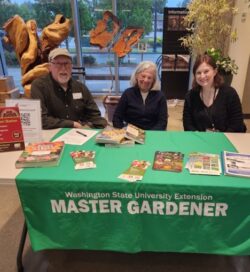 The Master Gardener Volunteer Program is about making these connections and being nurtured by nature. We’re readily available online to answer questions. You’ve probably seen our “Ask a Master Gardener” signs at the Arboretum or in a farmers’ market. I encourage you to talk to us. Some of my colleagues can tell you the Latin name for every plant in your yard; others, like me, are just good listeners who will help you figure out why your azaleas are drooping or what’s chewing holes in your hostas. Or maybe you’re interested in becoming a Master Gardener yourself. Here’s how.
When you’re talking with a Master Gardener, you’re outside breathing fresh air and learning how you can nurture your own plants and trees. That’s especially good for your community. Importantly for us, we love your questions and exploring answers together.

Contributor Sally Bagshaw is a Harvard Advanced Leadership Initiative alum, former three-term Seattle City Councilmember, and former Chief Civil Deputy for the King County Prosecuting Attorney’s Office. Sally is a lawyer, mediator, and advocate for government that functions responsibly. Master Gardener through the WSU Extension/King County program.