![AgeWise King County [logo]](https://www.agewisekingcounty.org/wp-content/themes/agewisekingcounty/images/logo.png)
Walking the Waterfront with our Favorite New Tool—The Tree Walk App!

Photo by Jana Robbins with permission from Trees for Seattle
We’re standing at the top of Overlook Walk. Sunlight bounces off Elliott Bay. Waves top and dance across the craggy peaks of the Olympic Mountains. There are few places on earth more beautiful than this, and for once we humans have added to nature’s splendor. Our waterfront is simply the “best in show.”
We listen to the songs of swallows and finches that have returned to their newly protected habitat. We breathe in the salty air. A low tide greets us with the pungent fragrance of decaying seaweed and decomposing sea life. We’re grateful to be West Coasters, and believe this is a great part of Puget Sound.
Now please zoom in with us.
To our right stands the Serbian spruce (Picea omorika) with its emerging purple cones and flattened green needles showing off their silvery undersides.
On the other side of the children’s climbing area is the aromatic Incense cedar (Calocedrus decurrens), with its deep green sprays of flattened branchlets.
We overhear a visitor ask, “What’s that stand of evergreen trees with the droopy tips?” We’re tempted to answer “Hinoki cypress.” Instead, we say in unison, “There’s an app to answer that!”
Initiated last summer, Trees for Neighborhoods, a program of Seattle Public Utilities, began developing an app you can take with you on walks along the waterfront. Currently, you can find 43 tree walks in different neighborhoods around the city, but you can only access them on a browser. This new app, called Waterfront Tree Walks, offers 41 tree tours throughout Seattle accessible on your phone. And—drumroll, please—the app will roll out just in time for Earth Day this year. Perfect for those interested in identifying trees, seeing the cultural decisions behind landscape design, and hearing stories from locals around Seattle.
Two of the trails in the app are along the waterfront. A shorter loop, from the Overlook Walk to the aquarium, is perfect for those wanting just a taste. A longer route informs deeply, and includes the Overlook Walk and runs south to Washington Street.
We are both waterfront advocates as well as dendrophiles, a.k.a. tree huggers. Ali is a professional arborist and urban forester; Sally is a Northwest native and master gardener and has been engaged with the waterfront designs and politics since 2004. We can hardly wait for the 900+ new trees and 150,000+ new plants to show off their spring leaves and blooms again.

Richard Hartlage from Land Morphology, designer of our Waterfront Park plantings, next to a Hinoki cypress
Come along with us on our longer Waterfront Park walk, which has been thoughtfully designed for all ages and abilities.
Notice first that the green corridor on the east side of Alaskan Way is much larger and lush. With the help of Friends of Waterfront Park and Seattle Department of Transportation, the east side trees and understory were planted three years ago while the Waterfront Park was being completed. A special thank you to Richard Hartlage of Land Morphology and James Corner of Field Operations from New York. Richard and James led the design of the space and selected each individual tree and plant, as well as ensured their vision and detailed planting practices were followed throughout this massive construction process.
The trees line Alaskan Way in mixed zones. Most are native from the Cascades to the coast, with a few non-native species to create visual interest and variety.
Beginning at Madison Street on the east side of the street, we’ll pass three types of deciduous trees lining the corridor: linden (Tilia cordata ‘Greenspire’), ash (Fraxinus americana ‘Junginger’), and sugar maple (Acer saccharum ‘Green Mountain’). Tulip trees (Liriodendron tulipifera ‘Emerald City’) and London plane (Platanus acerifolia var. ‘Exclamation’) leapfrog each other to heights of 50 ft. to 60 ft. near Lumen Field and T-Mobile Park.
On other blocks, deciduous zelkova (Zelkova serrata ‘Green Vase’) and elm (Ulmus americana ‘Princeton’) trees share the spotlight. These cultivars are becoming standards in urban areas because they are resistant to Dutch elm disease and can withstand industrial and urban air pollution. For a particularly beautiful example of a Zelkova serrata specimen, check out one of Sally’s favorite trees, on the corner of Alaskan Way and Spring St. The branching is intricate and the bark a striated gray. Sally touches this one with love every time she walks by.
Looking north, we see an array of oaks lining both sides of Alaskan Way. This stretch offers a series of three alternating oaks adjacent to the bike lanes up the hill to the Bell Street Parkway connection: Bur oak, (Quercus macrocarpa ‘Urban Pinnacle’); green pillar pin oak (Quercus palustris ‘Pringreen’), and regal prince (Quercus x warei ‘Long’).
If you can’t picture the trees mentioned above, fear not. The Tree Walk experience includes photos, names, and detailed descriptions. The app also provides some historical notes and many voices and anecdotes. For example, Bob Donegan, CEO of Ivar’s, offered this tidbit about the sugar maples:
“Sugar maples are adaptable and long-lived, often growing for hundreds of years. They are best known for their sweet sap that is the base for real maple syrup. One mature tree can produce up to 10 gallons of sap per season, and it takes roughly 40 gallons of sap to make just one gallon of delicious syrup.”

Ivar’s Bob Donegan with the sugar maple and his own bottle of maple syrup. Photo by Sally Bagshaw.
This sugar maple, located on the east side of Alaskan Way across the street from Ivar’s Acres of Clams, is a favorite. In 1947, a railroad car tipped on the waterfront and began leaking syrup. Ivar Haglund—the restaurant’s “flounder” and namesake known for his silly marketing—had his chef make giant pancakes. He took a picture ladling syrup onto the huge pancakes that appeared in all the Seattle newspapers.
Our waterfront is and has always been a cultural treasure. We are grateful to the Muckleshoot, Suquamish, Snoqualmie, Stillaguamish, Tulalip and other Salish Sea tribes who coordinated with the Waterfront Park designers to incorporate tribal art, plants, and storytelling into what we see today. Valerie Segrest, Muckleshoot Tribe, designed the gardens that top the Seattle Aquarium’s new ocean pavilion and are part of both walks.
Valerie and Colleen Echohawk introduced us to Camas lilies that create a wave of sky blue for weeks in May. One origin story describes Camas as a gift of the gods, left behind by the mischief-maker coyote to feed the people and make them smile. In the Waterfront Walk App, Colleen and Valerie share what this plant has meant to generations before us and continues to mean today.
We find ourselves in awe of and grateful to the many Seattle Center gardeners and safety team members for caring for the park and keeping it clean and welcoming for everyone.
The Waterfront Tree Walk experience offers much more detail and information on this and many other walks across Seattle. We are especially thankful to Richard Hartlage, Chris Nack, Jana Robbins, Cheyenne Conrad, David Shin, and Brad Vossahlik, who helped bring it online.
We look forward to walking with you on our waterfront soon.
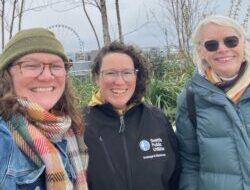
Creators of the Waterfront Tree Walk App Jana Robbins, Ali Lakehart and Sally Bagshaw. Photo by Jana Robbins
Authors: Sally Bagshaw is a former Seattle City councilmember, former chair of Allied Arts Waterfront for All, and a master gardener.
Ali Lakehart is the Trees for Neighborhoods program lead and a certified arborist who loves caring for public land, vital habitats, and nurturing people who nurture trees.