
Miyawaki Forests: Pockets-Full of Miracles, Part 1

Students take pride in their contribution to their community. Photo by Sally Bagshaw.
I started my political career when a few senior neighbors and I organized an effort to preserve a single fruit-bearing cherry tree in Lake Forest Park. Because of that tree, I ended up as a volunteer member on the Lake Forest Park City Council. Forty-five years later, that cherry tree still stands.
After practicing law for 31 years and serving 10 years on Seattle City Council, I continue to work across generational and political divides. A major area of tension in our city today has arisen between housing advocates and developers who are dedicated to building much more housing, and other neighborhood activists who prioritize preserving mature trees and expanding the tree canopy at the same time the housing is being built. Most people in these separate camps consider themselves ardent environmental stewards, yet their approaches differ and disagreements have sometimes devolved into name calling.
We need both right now: much more housing and many more trees.

Image reproduced by MxM Landscape Architects, republished here with permission from Seattle Parks Foundation.
According to studies in King County and Seattle, our region must build more than 300,000 housing units over the next 20 years to meet the needs of our growing and aging population. Building denser housing, especially affordable housing for all ages and abilities near transit, will address some of that critical human need. Yet we also need more housing in neighborhoods where there’s underdeveloped space, and in many cases neighborhoods that have been neglected in the past must be improved by making new connections with parks and green corridors. All this is expensive but necessary.
At the heart of the dispute is the fact that adding 300,000 more housing units will put tremendous pressure on the environment. Addressing this conundrum calls for agreements between advocacy groups and local government to require parks and green connections in neighborhoods before the new housing is built. This is not a new concept. As described in the first Bands of Green report in 1990 and updated in 2006, adding and preserving trees in every growing neighborhood must be at the front of mind while plans are being developed. Neighborhoods with trees and green connections are nicer places to live. Healthier, too.
Mayor Wilson’s recommendation to build “Taller, Denser, Faster” has much support among urbanists, and would gather even broader support if the approach incorporated the concept of “Greener.”
Here’s one illustration of what Taller, Denser, Faster, Greener could look like:
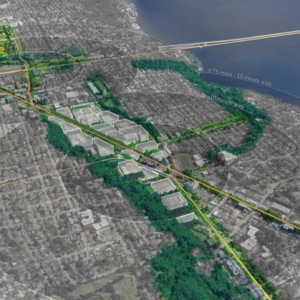
Mt. Baker aerial image created by MxM Landscape Architects, republished here with permission from Seattle Parks Foundation.
In Seattle, we have a 30% tree canopy goal. A tree canopy goal is more than an arbitrary number. It sets measurable targets across private and public land to protect and expand the number of our urban trees. This green canopy is directly associated with improving public health through improved air quality, managing storm water runoff, upgrading livability in our neighborhoods and more.
According to the City’s Trees for Seattle website, we have been losing ground toward that 30% goal for many years. Specifically, the most recent canopy study using 2021 data confirms that our city lost 255 acres of tree canopy this past decade across both public land which is host to 40% of our trees, and private property where 60% of our trees grow. To provide an image of what 255 acres of lost trees looks like, imagine 193 Seahawks stadiums side by side filled with mature trees and having those trees chain-sawed down in front of us at half time. That’s roughly equivalent to the 255 acres of tree canopy loss Seattle has sustained in the last 10 years.
To reach Seattle’s tree canopy goal, the math is straightforward: We must retain older native trees like Douglas fir and western red cedar whenever possible while we add younger, smaller trees to the mix. Arborists confirm that protecting the mature trees Seattle homeowners already have on their private land will have a big impact.
From an environmental standpoint, all trees are not considered equal. One mature Douglas fir provides approximately the same cooling capacity as 10 smaller dogwoods or vine maples. With thoughtful neighborhood design and reuse of underutilized land, we can save more of our legacy trees and meet our housing goals for all ages and economic levels, too. That’s admittedly a political reach, but there are ways each of us can help.
Big impact, small spaces: Miyawaki pocket forests
The Miyawaki forest style is named after the late Japanese botanist and ecologist Akira Miyawaki, who developed his way of planting pocket ecosystems using plants native to the area. He conducted 40 years of field trials and planted more than 1,700 pocket forests, mostly in Japan, China, and Southeast Asia, showing that even a small area, planted intently, with multiple layers of native trees and plants including a main canopy layer, sub-species companion tree layer, shrubs, and groundcover with properly prepared soil and maintenance, can greatly accelerate the growth of the forest and enhance the urban tree canopy. We can plant hundreds of pocket forests, too.

Planting day, Woodinville, Wash. Photo by Sally Bagshaw.
Using the Miyawaki method, people plant saplings and plants densely—up to five saplings and bushes per square yard—so they grow upward quickly. Miyawaki documented that densely planted native trees and plants thrive in neighborhoods at higher rates than other planting methods. His best-known book, published in 2007, is Healing Power of the Forest.
Miyawaki forests add more than just dense plantings to a neighborhood plot. These forests have a proven track record of promoting rapid greening in urban spaces, increasing native habitat for insects and birds, and making our neighborhoods more enjoyable for the rest of us. In our region, true natives like Douglas fir, western red cedar and hemlock would be the main canopy layer. Other adopted-native trees like incense cedar (Calocedrus decurrens), which have adapted well to our drier summers, may be excellent additions. And from the shrub world, natives such as red flowering currant, serviceberry, evergreen huckleberry, mahonia, and salal would contribute to a healthy northwest ecosystem.
Dozens of worldwide scientific studies confirm that tree canopies provide one of the most effective ways to create a cooler environment, cleaner air, and healthier neighborhoods for everyone. While our urban planners are developing ways to add housing and green connections at scale, we master gardeners and friends can contribute to smaller, manageable community projects and advocate for improvements in neighborhoods that have been denied support in the past.
Schools stepping up
Interest in planting Miyawaki-style pocket forests is gaining momentum in Seattle and King County as well as across the globe. Many local communities within the Puget Sound are already planting Miyawaki forests.

Robert Eagle Staff Middle School watering expert. Photo contributed by Sarah Ford.
Last December, Ethan Bryson, creator of Natural Urban Forests, along with local tribal stewards, Seattle Public Schools principals and leaders, parent Sarah Ford, and volunteers together planned a Miyawaki Forest for Robert Eagle Staff Middle School. On a 3,000-square-foot desiccated parcel of school land, teachers, students, and community volunteers researched native plants, studied the importance of biodiversity, prepared the soil, and planted over 1,000 native saplings and plants in five days. Sarah and her two children led volunteers to water the trees and plants this summer. Less than a year later, their pocket forest is thriving, and some of the trees are already taller than many of the student planters.
Many organizations have prioritized planting in and around schools, incorporating senior gardeners as mentors. Specifically, members of the Washington Native Plant Society volunteer with students and teachers to restore land in nearby schoolyards. Teachers have access to high-quality science curriculum such as that offered by Homegrown National Park and receive support through grants and volunteer gardeners to connect academic learning with hands-on restoration work on their school property.

Student planters at Rose Hill Middle School. Photo permission from curriculum creator Janneke Petersen.
In addition to the Robert Eagle Staff Middle School site, students, teachers, and experienced gardeners at Redmond’s Rose Hill Middle School studied the Youth Ecology Education through Restoration (YEER) program and planted together. One teacher commented that planning and planting the forest at her school has been the highlight of her 25 years of teaching.
Some teachers remarked that they have not seen this level of student interest when teaching ecosystems before, and their students become deeply committed to the restoration project. Some students proudly name their trees. You can see Nate’s tree above.
Students become science partners and restoration ecologists through aligned curriculum and personal commitment to their trees. Planting their forests generally happens in late October or November, giving teachers 6-8 weeks on the ecology curriculum starting early in the school year, moving into the perfect time for planting. Students report that they love working outside with their adopted older gardeners…once they overcome their initial reluctance, of course. They also say they feel less stressed.
What can we do?
We can’t wait for the federal government to address local climate change issues because that cavalry is not coming. State and local governments don’t have the budgets to plant thousands of desirable trees alone, nor can we wait for tree skeptics like Bill Gates and his fellow entrepreneurs to create a single techno-answer to solve for rising temperatures and bad air. I wouldn’t dare debate Bill Gates, but data is showing that trees are part of the climate answer.
This is where we gardeners and volunteers come in. The debates will continue, but what is clear is that the pocket forests bring welcome beauty and community commitment where planted. The budget for a single site like Robert Eagle Staff does not break the bank: $35,000 can pay for the planning, buying the plants, and prepping the soil. Volunteers with gloves and checkbooks can bring nature nearby into every neighborhood.
In Part 2 of this article, we’ll get specific.
 Sally Bagshaw is a former Seattle City councilmember, former chair of Allied Arts Waterfront for All, and a master gardener.