![AgeWise King County [logo]](https://www.agewisekingcounty.org/wp-content/themes/agewisekingcounty/images/logo.png)
Civic Coffee Recap: Social Connectivity
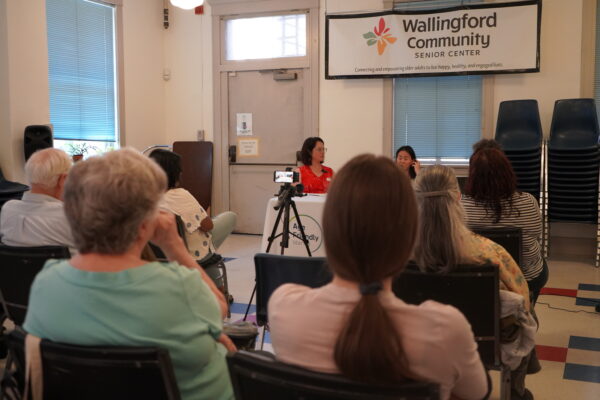
How can we strengthen social connections and support healthy aging?
This was the question explored during Age Friendly Seattle and The Seattle Public Library’s August Civic Coffee event, which focused on social connectivity, loneliness, social isolation, and hearing loss. The panel featured insights from Emily Ashado, manager of Program Operations at UW Medicine, and Jacqui Metzger, a volunteer with the Hearing Loss Association of America (HLAA). The event was moderated by Teresa Tam, Social Connection project coordinator at Greenwood Senior Center.
Loneliness and social isolation are not the same
Ashado explained that social isolation and loneliness are two different experiences. Social isolation is more objective: It describes having limited connection or engagement with other people. Loneliness, on the other hand, is the personal feeling of being alone, disconnected, or lacking meaningful relationships.
A person can experience both at the same time, but they do not always occur together. Someone may spend a lot of time alone without feeling lonely, while another person may regularly interact with others and still feel disconnected.
Recognizing this difference matters because the solution is not always simply telling someone to “get out more.” It is important to understand what the person is experiencing and what kind of connection is meaningful to them.

Click on the image above to watch a video recording of the Civic Coffee on social connectivity (YouTube, 57:37).
Look at the barriers, not just the individual
The panel also highlighted the importance of looking at the reasons behind loneliness and isolation. Ashado discussed how there can be stigma around loneliness, with people sometimes viewing it as a personal problem. However, many risk factors can be systemic or outside of an individual’s control.
Barriers may include accessibility, uncertainty, or changes in a person’s circumstances. Instead of assuming someone does not want to participate, families, friends, and community organizations can ask: What is making connection difficult, and what would make it easier?
This perspective can help communities create programs and spaces that meet people where they are.
Hearing loss can affect connection
Hearing loss was one example of a challenge that can make social connection harder. Metzger shared her own experience with hearing loss, and emphasized that communication often requires adjustments from both the person with hearing loss and the people around them.
Getting a hearing test can help people understand changes and establish a baseline. The Hearing Loss Association of America also offers information and resources, including information about hearing aids, Bluetooth technology, captioning devices, and other communication tools.
Friends, family members, and organizations can also make gatherings more inclusive by using microphones, choosing quieter spaces, improving lighting, and providing captions.
The panel also emphasized that conversations about loneliness, isolation, and aging should be normalized. Creating opportunities to talk about these experiences can help people recognize challenges and learn about available resources.
Start with one small step
Building social connection does not have to mean making a major change. It could be attending an event at the Seattle Public Library or a senior center, talking with a neighbor, reaching out to a friend, or asking for support with an accessibility need.
The goal is not to eliminate loneliness overnight. It is to understand the barriers, create opportunities for meaningful connection, and take one small step toward feeling more involved in the community.
 Contributor Siham Mohamed is a student at the University of Washington studying computer science and education policy. Mohamed is especially passionate about the intersection of technology, education, and community engagement, and how we can use research to create more accessible educational opportunities.