![AgeWise King County [logo]](https://www.agewisekingcounty.org/wp-content/themes/agewisekingcounty/images/logo.png)
Civic Coffee Recap: Chronic Disease Management
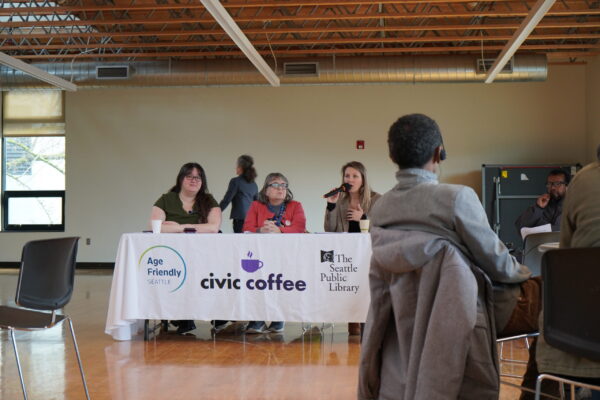
When it comes to managing chronic conditions, you are your best advocate. Doctors and pharmacists are there to support you.
These were key takeaways from Age Friendly Seattle’s and The Seattle Public Library’s February Civic Coffee event on living well with chronic conditions. The lively discussion featured insights from Aging and Disability Services’ senior planner, Mary Pat O’Leary (RN, BSN) and Kelley-Ross Pharmacy Group’s pharmacy resident, Holly Seyler (PharmD, MS). Here are seven tips the speakers shared on managing chronic pain.

Click on the image above to watch a video recording of the Civic Coffee on chronic disease management (YouTube, 1:01:09).
Tip #1: Focus on the one thing that’s bothering you the most.
One of the biggest challenges of having multiple chronic conditions is paying attention to all the symptoms you are experiencing at once. This can be overwhelming. By focusing on one thing that is bothering you the most, whether it’s pain, dizziness, blood sugar, or something else, you can more easily identify what you need.
Tip #2: Consolidate your prescriptions.
If you are filling prescriptions across two or more pharmacies, you can ask your favorite pharmacy to transfer your medicines from other pharmacies. They will need a list of your prescriptions and the pharmacies currently filling them. Then they can do the work of consolidating for you.
Getting your prescriptions filled at one pharmacy is safer because pharmacists typically make sure your medications don’t interact with each other in unsafe ways. They can’t check if they don’t know all of your medications. It is also more convenient for you to be able to only talk with one pharmacist.
Tip #3: Use pill organizers and phone alarms to remind you to take your medications at the same time every day.
Skipping medication or accidentally taking it twice are common mistakes when managing multiple medications. These mistakes can have detrimental health outcomes. Using simple systems to remind you and keep track of your medications can help prevent these mistakes.
Tip #4: Use your pharmacist as a resource.
Pharmacists can help you understand what your medications are for, how they work, and what their side effects may be. Any time you start or stop a medication, you can ask your pharmacist to review your medications and double-check that the combination is safe. You can do this with herbal supplements or remedies you use, too; just bring those bottles with you to the pharmacy. If you ever have to change how or when you take your medications, such as during a fast, you can ask your pharmacist if that is okay given the details of your medications and situation.
Tip #5: Use your doctor as a resource.
Before a doctor appointment, make a list of things that are bothering you, how long they have been bothering you, and questions that you have. Having a list prepared will help you make the most of your time with your doctor.
If you are experiencing side effects or having trouble taking all your medications, talk with your doctor. You can even ask them if you can take fewer medications. You are the only one who knows what’s going on with your body, so advocate for yourself. And be honest. The doctor should be your partner in managing your health.
Tip #6: Practice healthy sleep, eating, physical, and social habits.
Regular sleep, meals, physical activity, and social support all contribute to our overall health and well-being. You are a whole person. Give yourself grace and know that everything is connected to our health.
Tip #7: Share the details of your health conditions with one trusted family member, friend, or caregiver.
Make a list of your medications and conditions, including your history of conditions, and share it with a trusted family member, friend, or caregiver. You don’t have to be alone in your medical journey. Medical processes are easier to navigate together.
Age Friendly Seattle thanks Mary Pat O’Leary and Holly Seyler for sharing their insights and the East African Senior Center for partnering to host this Civic Coffee event. Watch the recording here and find out about the upcoming Civic Coffee here. Share this article with a friend to spread the wealth of knowledge. Remember: Focus on one thing at a time and know that you are your best advocate.
 Contributor Sonali Agarwal is an intern with Age Friendly Seattle. She is studying Law, Societies, & Justice and Environmental Studies at the University of Washington. To read more about Civic Coffee and other programs, visit Age Friendly Seattle.